UN COLONIAL CENSUS BUREAU — THE SETTLED SPHERE
The Bounds, Revised: Population and Projection Report, 2195 Bureau Publication No. 2195-1 November 2195 ES
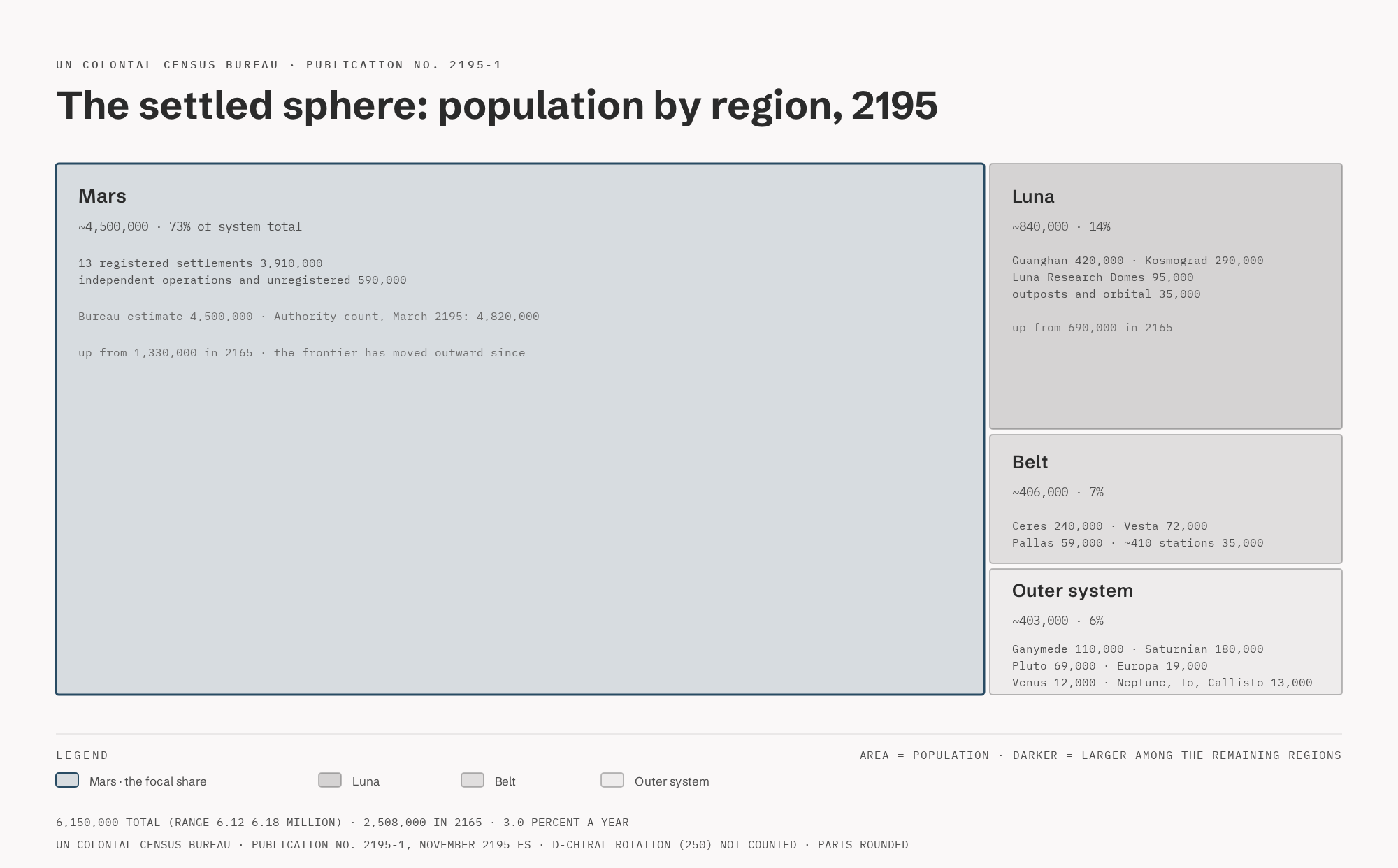
The Bureau’s system-wide compilation for 2195, issued every five years and superseding the 2165 report. Total confirmed sustained human presence beyond Earth: approximately 6,150,000 (range 6,120,000–6,180,000), up from 2,508,000 in 2165. The thirty-year growth rate is 3.0 percent per annum, less than half the 7.5 percent recorded between 2155 and 2165. Mars accounts for 73 percent of the total and 87 percent of the growth since 2165. The 2165 report’s projection of 32 million by 2200, and its 50 and 100 million scenario bounds, are withdrawn. The revised bounds are 7.0 million and 8.2 million.
1. Why the Bounds Moved
The 2165 report projected 7.5 percent annual growth, unchanged, and set its bounds at 50 and 100 million by 2200. Both assumptions were wrong in the same direction. The revision promised for 2185 is published now, after the Authority’s first full census cycle.
The 7.5 percent was not a trend. It was the Great Settlement: a licensed, scheduled migration of approximately 1.03 million people to Mars between 2155 and 2165, organized under UOCD charters and substantially complete within the decade. A one-time wave extrapolated across thirty-five years produced the 32 million figure. The wave ended.
The 2183 Council Decision on Martian Self-Determination gave the Martian Provisional Authority a binding veto over increases in licensed arrivals. The November 2181 capacity expansion, which would have raised arrivals from 100,000 to 160,000 a year, was suspended pending the Authority’s consent. The Authority has not consented. Net arrivals have run at approximately 95,000 a year since 2184, against the 160,000 the 2165 scenarios assumed.
The 2185 land transfer moved charter administration to the Authority. The charters are held for life, and on Mars lives have stopped ending, so the land does not turn over; new settlement licensing has slowed accordingly. The frontier has moved outward instead. The Jovian He-3 programme, the Saturnian greenhouse settlements, and the belt’s independent stations have grown faster than Luna, and slower than Mars at its peak.
2. Mars
Mars is counted as a separate reporting jurisdiction in this report for the first time. The Authority’s census, published in March 2195, reports 4,820,000 residents. The Bureau’s estimate, built from the Authority’s aggregate settlement returns under the 2185 transfer and from the Bureau’s own orbital survey, is 4,500,000. The difference of 320,000 is the Authority’s inclusion of unregistered residents and independent operations, which the Bureau does not enumerate.
The thirteen registered settlements account for 3,910,000. A further 590,000 are at independent operations, unregistered sites, and the operational camps that the 2165 report counted at roughly 15,000.
| Settlement | Est. 2165 Pop. | Est. 2195 Pop. |
|---|---|---|
| Pobeda Station | ~215,000 | ~480,000 |
| Utopia Basin Station | ~145,000 | ~420,000 |
| Meridian Forge | ~135,000 | ~400,000 |
| Olympus Highport | ~125,000 | ~380,000 |
| Hellas Greenbelt | ~120,000 | ~360,000 |
| Chryse Basin Works | ~105,000 | ~320,000 |
| New Plymouth | ~90,000 | ~300,000 |
| New Elysium | ~80,000 | ~250,000 |
| Isidis Rise | ~75,000 | ~230,000 |
| Arcadia Icefields | ~70,000 | ~220,000 |
| Melas Station | ~65,000 | ~200,000 |
| Eos Station | ~55,000 | ~190,000 |
| Sirenum Reach | ~35,000 | ~160,000 |
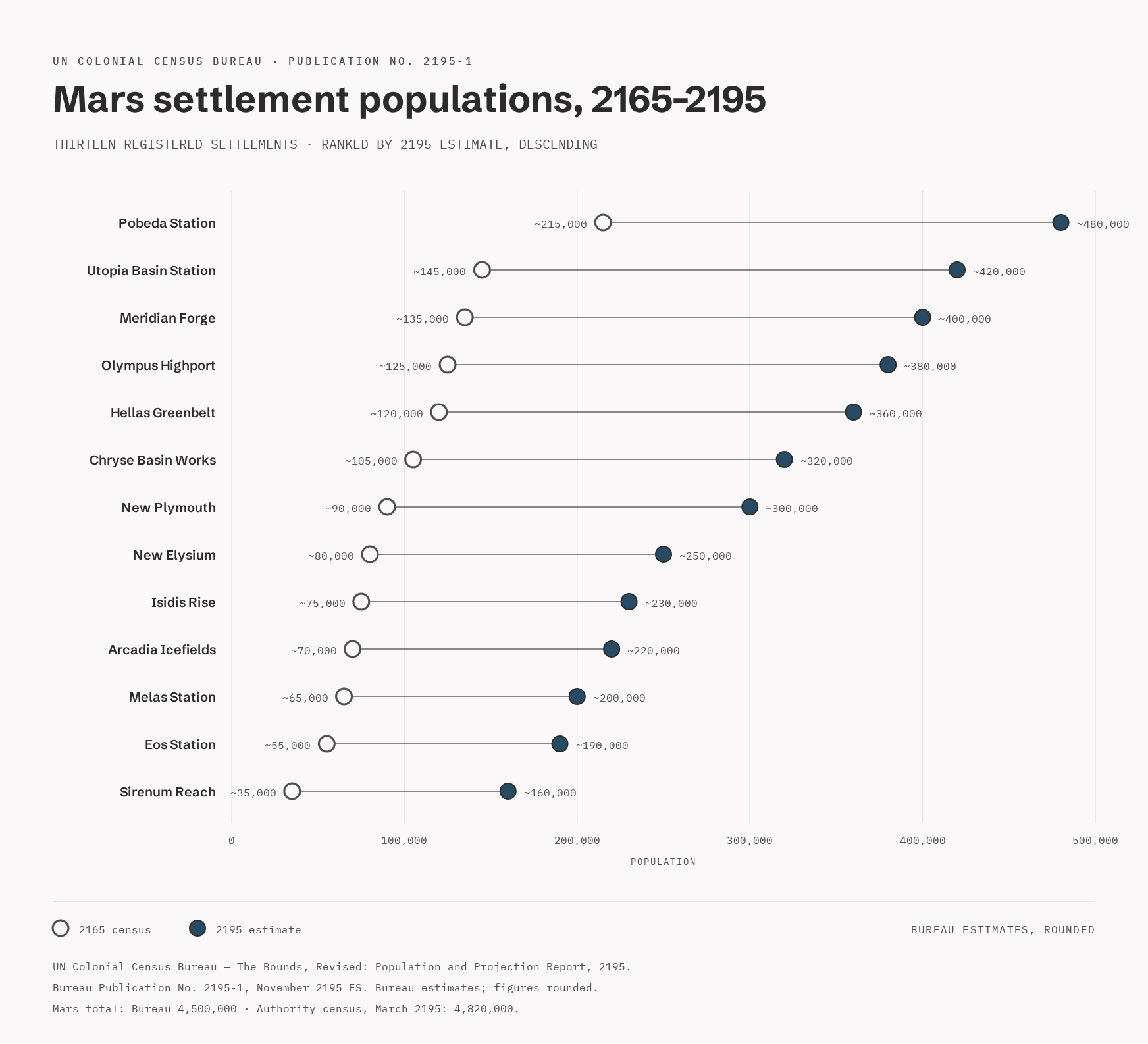
Martian growth since 2183 has run at approximately 3.4 percent a year, down from 4.6 percent between the 2165 census and the 2183 decision. The 2183 report’s figure of roughly three million residents is consistent with the Authority’s returns.
The Bureau no longer maintains a Martian registration register. It receives an annual aggregate return from the Authority and cross-checks it against the orbital survey and the arrival manifests filed at Olympus Highport and Isidis Rise. Where the two figures differ, the Bureau publishes its own estimate and the Authority’s count side by side. It does so here.
3. Luna and the Earth-Luna System
Luna’s population is 840,000, up from 690,000 in 2165, a growth rate of 0.7 percent a year. Guanghan holds 420,000, Kosmograd 290,000, the Luna Research Domes 95,000, and outposts and orbital facilities 35,000. Cislunar infrastructure is at capacity, and the Bureau does not project growth above one percent a year before 2200.
The ELTS I–VI network continues to handle all Earth-Luna passenger traffic. Earth orbital infrastructure is unchanged in population terms.
4. The Belt
Ceres — 240,000, up from 156,000, still the Belt’s administrative, medical, and civil hub. The water trade and the SP clearing system remain the settlement’s economic base.
Vesta — 72,000, up from 47,000. Pallas — 59,000, up from 39,000, and now also the construction site of the Ark.
The independent stations number approximately 410, with combined staffing estimated at 35,000, up from 320 stations and 19,000 staff in 2165. The Sovereign Miners’ Coalition’s 247-station membership figure predates the current count and is not the Bureau’s.
5. The Outer System
Ganymede — 110,000, up from 60,000, the outer system’s principal food-production hub and the main construction base for the Jovian He-3 programme. Europa — 19,000; Io — 5,000; Callisto — 2,000.
The Saturnian system holds 180,000, up from 100,000: Titan surface 88,000, Boreas Station 49,000, and the moons 43,000. The D-chiral research settlements operate under standing access protocols within the moon population.
Neptune — 6,000, up from 2,500. Pluto — 69,000, up from 45,000, with Persephone Reach at 55,000 and the remaining population at the surface habitat complex and the Canteloupe. Venus — 12,000 at Aphrodite, up from 5,500.
The nine confirmed D-chiral worlds host the research network at approximately 250 personnel on rotation.
6. The 2200 Bounds
The revised bounds replace the 50 and 100 million figures. They are scenario bounds, not forecasts, and they assume no change in the arrival framework.
| Scenario | 2200 total | Mars | Luna | Belt | Outer system |
|---|---|---|---|---|---|
| Low | 7.0 million | 4.9 million | 0.9 million | 0.5 million | 0.7 million |
| Central | 7.5 million | 5.1 million | 0.9 million | 0.6 million | 0.9 million |
| High | 8.2 million | 5.4 million | 1.0 million | 0.7 million | 1.1 million |
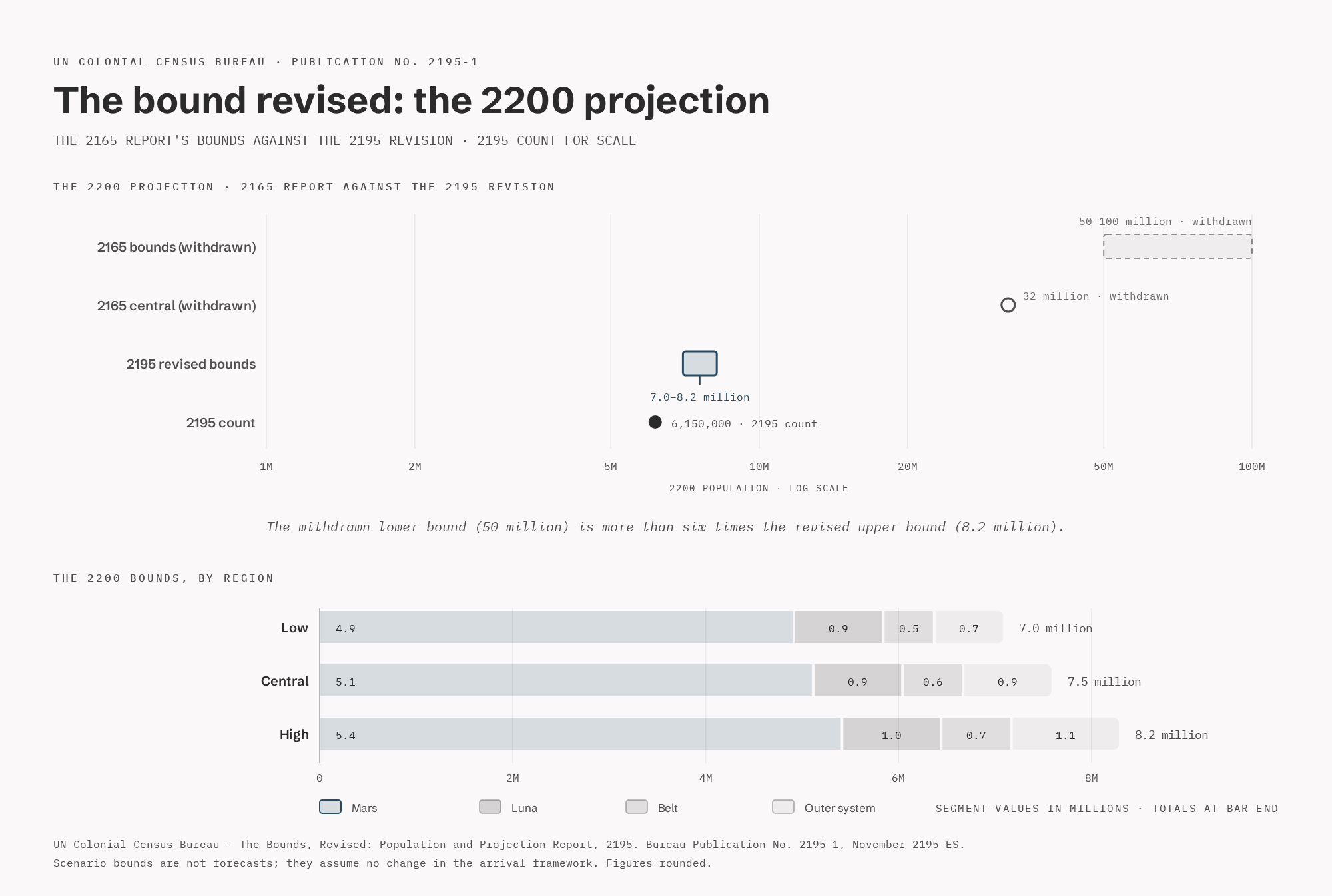
The low bound assumes the Authority continues to refuse an increase in licensed arrivals and the outer-system programmes proceed at their current schedules. The central bound assumes arrivals remain near 95,000 a year. The high bound assumes the Authority consents to the suspended 2181 expansion and the Jovian programme adds a second construction base. None of the three assumes Mars returns to the growth rate of the Great Settlement.
The 2165 report’s lower bound, 50 million, is now more than six times the revised upper bound. The Bureau withdraws it and the 32 million extrapolation with it.
7. Method and Limitations
The Bureau counts registered residents of UN-administered settlements and of reporting jurisdictions. It excludes populations in transit between bodies, the Hygiea garrison, and the sealed research levels. Mars figures are the Authority’s aggregate returns; independent belt stations are sampled, not enumerated; the D-chiral network is a personnel rotation count, not a resident population.
Three limitations are material. The Martian count is a negotiated figure, not a Bureau enumeration, and the two numbers will differ until a joint method is agreed. The independent belt stations are undercounted by design, because they do not report. And the 2200 bounds depend on a single administrative decision, the Authority’s arrival consent, which the Bureau cannot model.
8. What the Numbers Mean
The settled sphere is smaller and slower than the 2165 report expected. It is also less Martian. In 2165 the Bureau projected a system of tens of millions of people, most of them on Mars, arriving at 160,000 a year. The 2195 count is six million people, three-quarters of them on Mars, arriving at 95,000 a year, and the frontier has moved to the Jovian and Saturnian systems. The 2165 bounds were not wrong about the direction of growth. They were wrong about its size and its address.
The next compilation is due in 2200, the first after the Ark’s departure.
This report excludes the Hygiea garrison population and populations in transit between bodies.