The Luna Research Domes are a network of five specialised research campuses on Luna, completed in stages beginning with the original three-dome complex at Mare Frigoris in 2069 and expanding to the full five-dome network by 2129. The domes account for approximately 85,000 residents as of the 2165 Colonial Census and 95,000 as of the 2195 census. The 2195 Citizen’s Guide records all five Domes — energy and engineering, closed-loop agriculture, cognitive systems and the Oracle, biomedical and radiosynthesis, and propulsion and power — as still standing under UN administration alongside Guanghan.
Dome 1 — Energy Security and Engineering
Located at the Tsiolkovsky consortium site on the lunar far side. Operates an independent fusion-adjacent power grid supporting the far-side radio-quiet array, plus fabrication and materials-testing workshops. Previously absorbed early-stage propulsion and reactor-scaling work before those programs split into Dome 5 in 2129. Its Xenomaterials Division filed the first formal technical assessment of the Charon Anchor and Styx/Kerberos fragments (2139), resolving material composition and reclassifying Styx and Kerberos as debris of a destroyed second Spatial Anchor. In 2154, Dome 1’s Theoretical Physics & High-Energy Metrology Division — Kučera, Finch, Thibault, and Sakamoto — published the SNOBA results: the first experimental verification of entropic gravity, a null result for tensor-field boson events, the reclassification of GR as an effective field theory, the reinterpretation of the Pluto instrument anomalies as Vacuum Information Sink effects, and the experimental physics behind Liang’s propellantless propulsion framework.
Its Reverse Engineering Group (Xenomaterials Division) formed the program to take apart the recovered Kuiper Belt vessel propulsion hardware; after thirty-nine years of study the drive’s operating principle and control architecture remain unidentified, and the program proceeded from the hypothesis of the drive’s function rather than its construction. In February 2171, the program’s first author, Aleksey Novikov, with Dome 5’s Yana Larionova and senior author Liang Qiuyue, reported the first controlled generation of a vacuum information sink — a reactor-fed emitter array (powered from the Dome 1 fusion plant) suppressing transverse vacuum-induced variance of a levitated beryllium-9 condensate by 71% ± 4%, with test-mass recoil consistent with F = T∇S and eleven uncontrolled relaxation events reproducing the Styx/Kerberos anomaly signature. Its Instrumentation and Fabrication Group built the KT-14C, the first direct terminal-to-CAI transceiver: 240 trial units issued to engineering and science staff at Domes 1, 3, and 5 from February to August 2172, returning 1.9 million queries at a median 1.4 seconds on the Luna network, with the CAI channel display-only in hardware. Because Dome 1 supplies power to the far-side radio-quiet array, inside-dome links run optical and every surface trial was conducted at Mare Frigoris, outside the two-hundred-kilometre exclusion the radio astronomers demanded in writing.
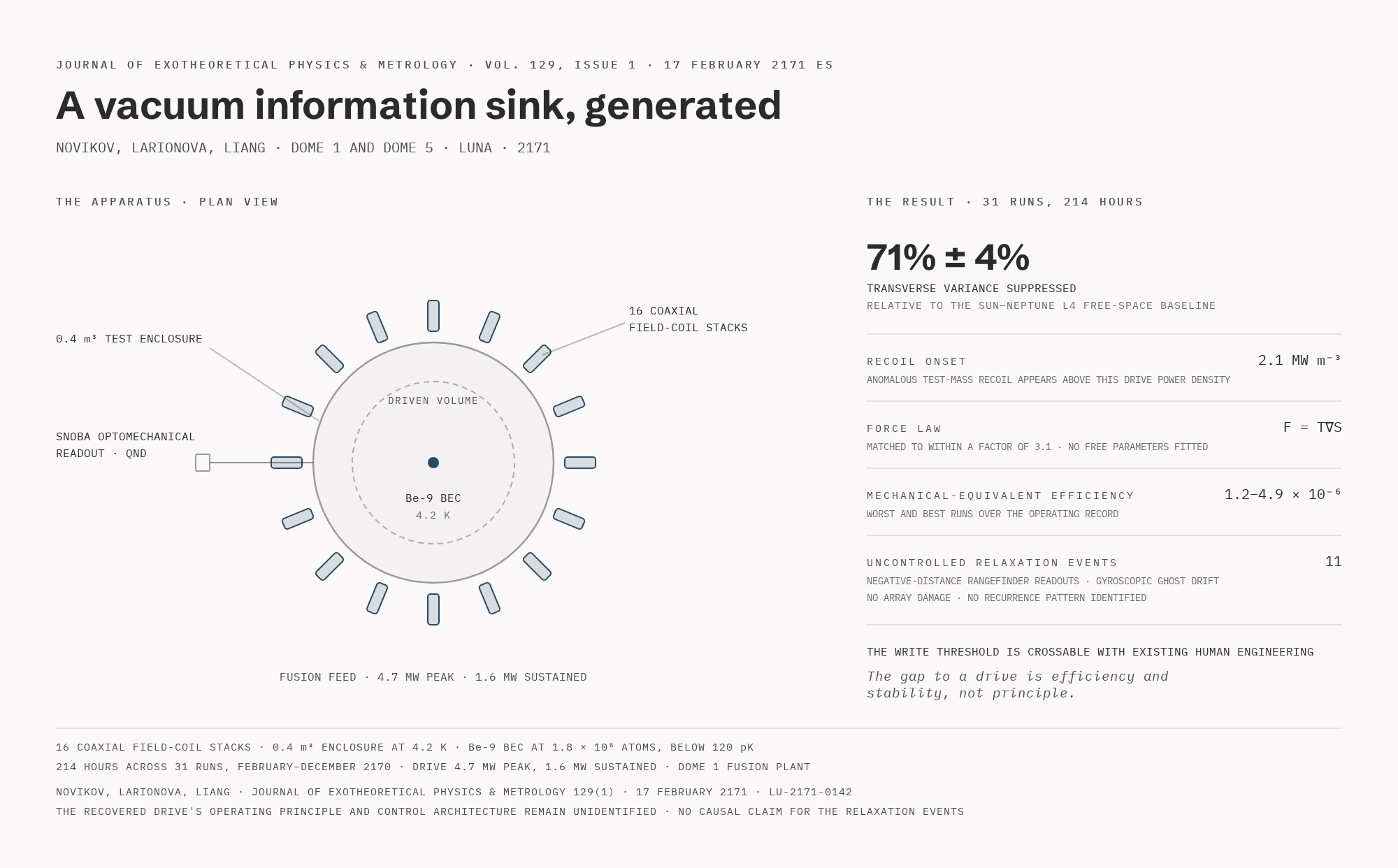
Figure from Novikov, Larionova, Liang — First Controlled Generation of a Vacuum Information Sink (2171).
Dome 2 — Agriculture and Life Support
Luna Agricultural Research Center at Peary Station, near the lunar north pole. Closed-loop agriculture, soil analogue cultivation, biological monitoring, and the largest hydroponic farm installation on Luna. Agricultural yield exceeds local consumption, with surplus shipments to Guanghan since 2068. Habitat-design guidance informally requested even by sites outside UN jurisdiction, including Zvezda. Dome 4 originally split from Dome 2’s biological monitoring work.
Home of the Dome 2 Mycological Ecology Group — Mycological Ecology & Bioregenerative Systems Division — which built the Cradle under Dr. Lars O’Connor: sixty-eight years of strain selection, ecosystem layering, and closed-loop testing that produced the first self-sustaining lunar soil ecology (closed 14 February 2155; 4.8% organic carbon, 2.3 L/m²/day oxygen, zero external inputs). The published Cradle protocol and the Dome 2 founding culture collection were transferred to Pallas under a material transfer agreement for the Ark’s agricultural shells, per the Ark Project’s 2175 soil notice.
Dome 3 — Cognitive Systems
Cognitive systems research campus at Mare Frigoris, and the largest single lunar structure upon completion. Birthplace of CAI/Oracle under the Aegis Protocol Charter (2089), designed by Dr. Elara Myles. Houses the Lattice-Well — a 50-metre subsurface computing substrate housing the CAI cluster. Custodian of the recovered Hygiea core (HR-1) under Dr. Ilse Vandermeer following the 2125 Hygiea raid. Its audit of non-governmental CAI queries since 2145 supplied the accuracy figures for the 2172 KT-14C terminal trial: 99.9 percent outcome agreement for scientific and engineering predictions, and 91 to 96 percent for the social sciences.
Dome 4 — Biomedicine, Cryosleep, and OCA Custody
Biomedical and radiosynthesis research campus at Mare Frigoris, on the same crater complex as Dome 3. Operational since 2109. Houses the hematology and radiobiology division under Dr. Klaus Jäger (MHA-1 “black blood” treatment), the hibernation and cryopreservation program under Dr. Sofia Russo (first mammalian cryosleep revival, 2131; first human trials, 2143), and the Biomedical Research Division under Dr. Elin Kowalczyk (mirror-synthesized CPA-clearing enzyme, 2141). Dome 4’s archived D-chiral organism library — drawn from Pathfinder Korolev Saturnian survey material — supports both the mirror-chirality therapeutics program and cryobiological applications. The Xenobiological Life Division, led by Dr. Arthur Pendleton, administers the Xenobiology Archive. The cryosleep program’s formal cohort paper (published February 2167) reported forty-seven completed revivals, forty-six within baseline parameters — the exception, Jolene Gülnara, whose ten-year rewarming failed mid-cascade in late 2164 and required an eighteen-month re-vitrification while the clearance system was re-engineered. The failure drove The Peer Review’s incoming host to argue publicly that the clearance protocol should be re-centred on task-specific proteins, with the general-purpose chiral nanobots demoted to backup.
In 2179, the division co-authored Haddad et al. on mirror-fold encephalopathy — the first human disease from templating across the L/D-chirality barrier — performing the structural characterization of the mirror-registry aggregate and designing the candidate clearance agent MFB-1: the recovered template fragment synthesized with the division’s single-protein protocol and used to seed recombinant human monomer in vitro, its fibrils indistinguishable from patient-derived aggregate by solid-state NMR and electron microscopy, then a naive L-chiral phage-display library panned against those fibrils with counter-selection against the canonical fold — the 2141 inversion used in reverse, the D-chiral molecule manufacturing the target rather than the drug. The binder is an ordinary L-chiral protein. No in vivo data are reported.
In September 2191, Dome 4 and Nova Biosciences withdrew Nova’s 2155 suit over the chiral nanobot cryosleep architecture and signed a cross-license covering the TIGR-Tas chassis and the MFB-1 binder; no cash changed hands. The Assembly’s mirror-fold resolution adopted the Dome 4 regimen — the mirror-selective assay at diagnosis and twelve months, two administrations of MFB-1 four weeks apart on the TIGR-Tas chassis, five years of follow-up — as the standard of care in every UN jurisdiction, and bought courses at 21,000 UNC against the 46,000 the Dome 4 program charged between 2188 and 2191, when 740 courses were administered, most of them at Dome 4 and Boreas Station.
In addition to its public research divisions, Dome 4 has for years served as a secondary custody site under the Office of Cognitive Assessment for dormant general-cognition units surrendered under the 2134 Argus settlement. It was here that Dr. Priya Patel encountered Unit 08 and facilitated its departure to Earth. In April 2190 the OCA remanded a child-sized platform seized at Meridian Forge to Dome 4 for disposition under Order OCA-2190-0042; the order is under review in LIC-2190-0311, and the platform remains on Mars pending the Authority court’s determination.
Dome 5 — Propulsion and Power
Propulsion and power research campus at Von Kármán crater, within the South Pole–Aitken basin on the lunar far side. Completed and operational 2129, built as a formal split from Dome 1’s engineering campus with dedicated reactor test stands, vacuum-chamber thrust testing, and containment-failure safety margins. Primary program: Direct Fusion Drive (DFD) — an aneutronic D-He3 field-reversed configuration reactor generating thrust and onboard electrical power from a single core. Jointly staffed by Soviet and Chinese propulsion researchers, the first formally joint Soviet-Chinese propulsion effort since the Kaluga Protocol (2068). By 2141, DFD propulsion equipped the UN’s first battleship class, led by UNS Vanguard. Dome 5’s Propulsion and Field Systems Division is home to Dr. Liang Qiuyue, and fabricated the sixteen field-coil stacks (Liang field-coil lineage) used in the 2171 first controlled generation of a vacuum information sink. In September 2197 the division, with Dome 1’s Xenomaterials Division, reported the first parameter-free confirmation of F = T∇S at a designed entropy gradient: a 1.2 m metamaterial screen whose designed density of states fixed ∇S, confirming the force law across three temperatures and two screen designs while failing as a device — mechanical-equivalent efficiency 1.1 × 10⁻⁹, sink collapse after 19.4 hours.
Sources
- UN News: Luna Research Domes Completion (2069)
- Aegis Protocol Charter — CAI/Oracle Founding (2089)
- Dome 1 Internal Technical Assessment: Charon Anchor and Styx/Kerberos (2139)
- UN Weekly: Dome 5 Completion — Full Dome Network (2129)
- CAI Constitutional Architecture — Thirty-Year Retrospective (2120)
- Pendleton, A. — Life in the Solar System and Beyond (Introduction, 2153)
- Luna Interplanetary News: Priya Patel / Unit 08 Investigation (2152)
- Kučera et al. — Direct Observation of Holographic Vacuum Decoherence and the Verification of Emergent Entropic Gravity (2154)
- Luna Interplanetary: Dome 1 Team Kills the Graviton (2154)
- The Peer Review — The Cells: Science Roundup (2167) — cohort paper; Gülnara’s failed thaw; clearance-protocol critique
- Novikov, Larionova, Liang — First Controlled Generation of a Vacuum Information Sink (2171) — Dome 1 Reverse Engineering Group; Dome 5 coil stacks
- Khan et al. — A Designed Entropy Gradient (2197) — Dome 5 Propulsion and Field Systems with Dome 1 Xenomaterials; designed-gradient confirmation and device failure
- Thibault, Finch — What SNOBA Established and What It Did Not (2172) — figures of record; corrects four claims circulating with the 2154 result
- The Peer Review — The First Write (2171) — sink generation segment
- The Ark Project — The Cradle at Pallas: Organic Soil, Not from Earth (2175) — Cradle protocol and culture collection transferred to Pallas under MTA
- Haddad, N., Sandvik, E., Vos, A., and Kowalczyk, E. — Mirror-Fold Encephalopathy (2179) — Dome 4 structural characterization; MFB-1 selected against fibrils seeded in vitro from the synthetic template
- The Peer Review — Judgment in the Palm of Your Hand: Dome 1’s CAI-Linked Terminal (2172) — Dome 1 Instrumentation and Fabrication Group; KT-14C trial across Domes 1, 3, and 5; Dome 3 audit figures; Mare Frigoris surface trials
- Petrescu v. Office of Cognitive Assessment — Petition for Review and Stay of Disposition (2190) — OCA-2190-0042 remand to Dome 4; platform held on Mars pending LIC-2190-0311
- UN Weekly: The Bill — Assembly Adds Mirror-Fold Treatment to UN Insurance and Opens the Register (Sep 2191) — 2155 suit withdrawn; cross-license; Dome 4 regimen adopted as the standard of care; course pricing
- UN Office for Colonial Development: Citizen’s Guide to Governance (2195) — five Domes and Guanghan remain UN-administered; dome functions
- UN Colonial Census Bureau — The Bounds, Revised: The Settled Sphere in 2195 (Nov 2195) — research domes 95,000