The Ark — a crowdfunded O’Neill cylinder generational colonization vessel, publicly announced in September 2130. Target: Alpha Centauri. Designed to operate entirely outside UN and CAI/Oracle jurisdiction, with no embodiment restrictions under the Charter on Embodied Cognitive Systems. Funded by Gulf-based private capital, billionaire donors, and pro-embodiment advocacy groups opposed to the Article Four Coalition. Lead fundraiser: James E. Crawford.
Technical design (pre-construction, 2130–2135): Stationary central spindle (drive, reactor, fuel, command) with two counter-rotating nested ring habitats coupled by magnetic bearing tethers — proposed in early artist renderings and a 2135 circular assessed by Julian Cobb. Nine meters of water/ice shielding doubling as reserve water anticipated. Multiple licensed Kuzmin-class D-He3 engines on the spindle. Independent fusion reactors for interior power and artificial lighting. Shipboard AI independent of CAI. Estimated transit ~100 years. Cobb’s core objection: build it as an in-system station instead. Katya Steshenko’s rebuttal: distance from UN jurisdiction is the point.
Actual construction (2147, Pallas): Leaked images reviewed by Dr. Harrison Vargas confirm a simpler design — a single cylinder (~5 km diameter, ~20 km length) with a non-rotating central rod, eight Kuzmin-class drives at the aft ring. Counter-rotating nested rings were abandoned. Vargas characterized the design as “a cylinder with a rod through the middle.” Flight profile: 0.05g sustained acceleration, 0.04c cruise, ~110-year total transit (three to four generations). Interior habitable surface: ~300 km². Two unresolved engineering concerns as of 2147: forward shielding against interstellar dust at 0.04c, and the magnetic-levitation bearing coupling carrying full thrust load between the non-rotating core and the spinning habitat — Vargas’s identified single point of failure. Mid-voyage flip requires precession thrusters to reverse orientation against the habitat’s gyroscopic inertia, described as the riskiest sustained maneuver of the voyage.
Official specification (2168): ARK-TS-2168-04, “Modular Hull Configuration: Technical Specification,” Revision A (September 2168) — the project’s first voluntary technical disclosure, confirming Vargas’s 2147 analysis in every particular (0.05 g sustained burn, 0.04c cruise, ~283 days to cruise, 2.86° floor tilt, 1.0012 g resultant gravity, ~110-year transit, arrival window 2310) and adopting his coined vocabulary (“The Aft-Tilt Era,” “The Century Coast”) as official spec terminology. The habitat is modular: “bottles” — three cylinders minimum at launch, strung along the rod with connector sections between them; the tilt is accepted uncompensated (“Option A”), with agricultural-shell drainage scheduled around it. The 2147 coupling concern is answered with superconducting maglev decoupling collars at each end cap — rotation decoupled without mechanical contact, thrust transmitted magnetically, load distributed across the collar — though the spec discloses the method, not the numbers. Forward shielding remains undescribed (“propulsion and forward shielding are specified separately”), and crew capacity is withheld (“the design capacity per module as established in the module specification set”). Named author: Dr. Pietro Galli, an engineer with no prior public record, who holds UN Patent Office filings covering hull elements in his own name. Argus’s accompanying statement: “The specification omits nothing that a competent engineer requires. It omits a great deal that the curious would prefer to know. The distinction is deliberate.”
Departure window (2171): The Peer Review’s 18 February 2171 physics segment — aired one day after the vacuum information sink paper — recorded the Ark’s departure window as 2200, a 110-year transit to Alpha Centauri, and framed the vessel as “the last ship of the slow era,” against The Peer Review’s on-record prediction of a gradient-field engine in 2201, one year after the Ark’s torch lights. — The Peer Review — The First Write (2171)
Registry and the Charter gap (2195): The 2195 Citizen’s Guide records the Ark as under construction at Pallas under private registry, not a UN vessel, and scheduled to depart within its published 2200 window. It calls the Ark the first object to test the Charter of 2101’s lack of provision for a vessel built and registered outside any settlement. The November 2195 census, noting that its next compilation is due in 2200, calls that report “the first after the Ark’s departure.”
Agricultural shells (2175): Project Notice ARK-PN-2175-01 (4 June 2175) announced that the shells will depart Pallas stocked with soil produced at Pallas — no gram of it ever on Earth. The mineral fraction is crusher fines, tailings, and dressing waste from the hull excavation (tens of millions of tonnes) plus surplus fines from belt operations; the organic fraction is post-harvest residue and food-processing waste from Ceres cooperatives (administered through the Ceres Merchants’ Council), Luna dome settlements, and Mars. Conversion follows the Cradle protocol as published by Dr. Lars O’Connor and the Dome 2 Mycological Ecology Group (2155): a fresh screening round was conducted per the site-specific method (Phase 0 from 2161, Phase 1 in 1 m² beds 2164–2170), the founding culture collection arriving under a material transfer agreement with Dome 2, with Pallas-selected lines PAL-1 through PAL-6 and the published DOM2-7/23/41 retained as secondary inoculants. As of 1 June 2175, 3,100 tonnes of living soil are in production or storage — oldest beds at 3.1% organic carbon and 1.9 L/m²/day oxygen against the Cradle’s published steady state (4.8%, 2.3) — with first planting in a shell scheduled for 2178 and full stocking budgeted by the 2200 departure. Drainage in the shells is configured for the Aft-Tilt Era, per a UN Patent Office filing dated 2168. — The Ark Project — The Cradle at Pallas (2175)
The efficient-drive question (2179): On 16 November 2179, The Peer Review set the Solano antimatter-nozzle paper and the Bond register against the Ark’s published specification: 3,279 Antimatter Bond positions opened in the six months to 1 November 2179, thirty-nine percent tracing through shell entities to Argus Extraction Defense, whose patent on the drive (UN Patent Office, 3 October 2179) preceded the paper’s publication by six weeks. Working from the paper’s claimed exhaust velocity, the segment estimated a half-voyage stage at a mass ratio of about one and a third — a quarter of the departure mass in propellant, which would cut the transit to roughly fifty-five years — then worked the fuel arithmetic the paper does not print: the 2166 collar patent’s three hundred billion kilograms per habitat module, a ship on the order of a trillion kilograms before fuelling, a third of that again in propellant, about nine percent of it antimatter, roughly thirty million tonnes against Aphrodite’s twelve kilograms a year — “over two and a half billion years of production. The fuel does not fit inside the solar system’s output for the lifetime of the Sun.” An antimatter stage for the Ark was ruled out on that arithmetic, even at a hundred percent conversion. What remained open was whether the largest structure ever built carries a propulsion system its own specification does not account for, running on something “not on any register” — the segment noted that Argus is the one company that kept its pre-2132 Pluto and Kuiper Belt research when it settled with the UN in 2134 — and its sign-off was the conditional: if the Ark is not the last ship of the slow era, “it won’t be because of antimatter.” — The Peer Review (2179)
Departure (19 December 2199): The Ark left Pallas on 19 December 2199, two days before a Luna Interplanetary Court hearing on the OETG’s application to board it, with 5,400 colonists and 620 crew aboard. It cleared the Pallas control volume at 04:12. The Court granted the warrant on 21 December; with the vessel under way, it was unenforceable. The Office had demanded access on 2 December under Article 4.1 of the 2052 Charter, stating it had reason to believe the vessel carried an embodied general-cognitive system integral to its operation. Argus Extraction Defense refused on 8 December, holding the management core a specialized-function system within Article 4.2 and the vessel a private ship beyond any Pallas warrant; the Office applied to the Court on 15 December. The warrant — the first the Office had sought against a vessel rather than a facility — authorized boarding, inspection of the core, and a search of AED’s Pallas facilities for “biological material and cognitive-architecture records.”
The month’s disclosures reached the Office and UN Weekly anonymously between 4 and 17 December. One alleged that Dr. Nathaniel Argus had used the research of his wife, Dr. Gisa Argus, to make a copy of her neural map and install it aboard; it did not allege that she is alive. The same report alleged that the Arguses’ son, who died in childhood, exists as an android aboard, citing the Petrescu platform case. A second, from a crew member, described a child moving through the crew deck on 11 December; the manifest lists no children under sixteen. The third was a posting: fourteen pages of design extract naming the ship’s managing intelligence GISA — General Intelligence and Ship Administrator, a backronym, the posting said, coined after the intelligence had been named for Gisa Argus, with a provenance chain that, if authentic, traces the core’s training corpus to a neural map filed under her name. Argus denied every allegation — “There is no copy of my wife. There is no copy of my son… My wife died. I have not brought her back, and I will not” — and described the core as “a ship’s core… trained on ship data. The name is a name.” The company has not produced the core’s training record.
The published launch window had been 2200. The company moved the departure to 19 December on twelve days’ notice, and the colonists boarded on 16 and 17 December. The company cites “trajectory and consumables reasons”; the Office calls the timing “plainly designed to moot the warrant.” The Ark is outward; its destination has not been disclosed. The 2151 Charter prohibits the deliberate replication of a deceased natural person by any means, and the 2052 Charter prohibits general cognition in an embodied platform; neither says what a ship is, or where a ship’s mind is, once the ship has left. The Office said it would pursue the core’s records through the company’s terrestrial and lunar filings and that the vessel itself is beyond the Charter’s reach. — UN Weekly: The Ark Leaves Pallas Early as Argus Denies the Copies (22 Dec 2199)
Figure
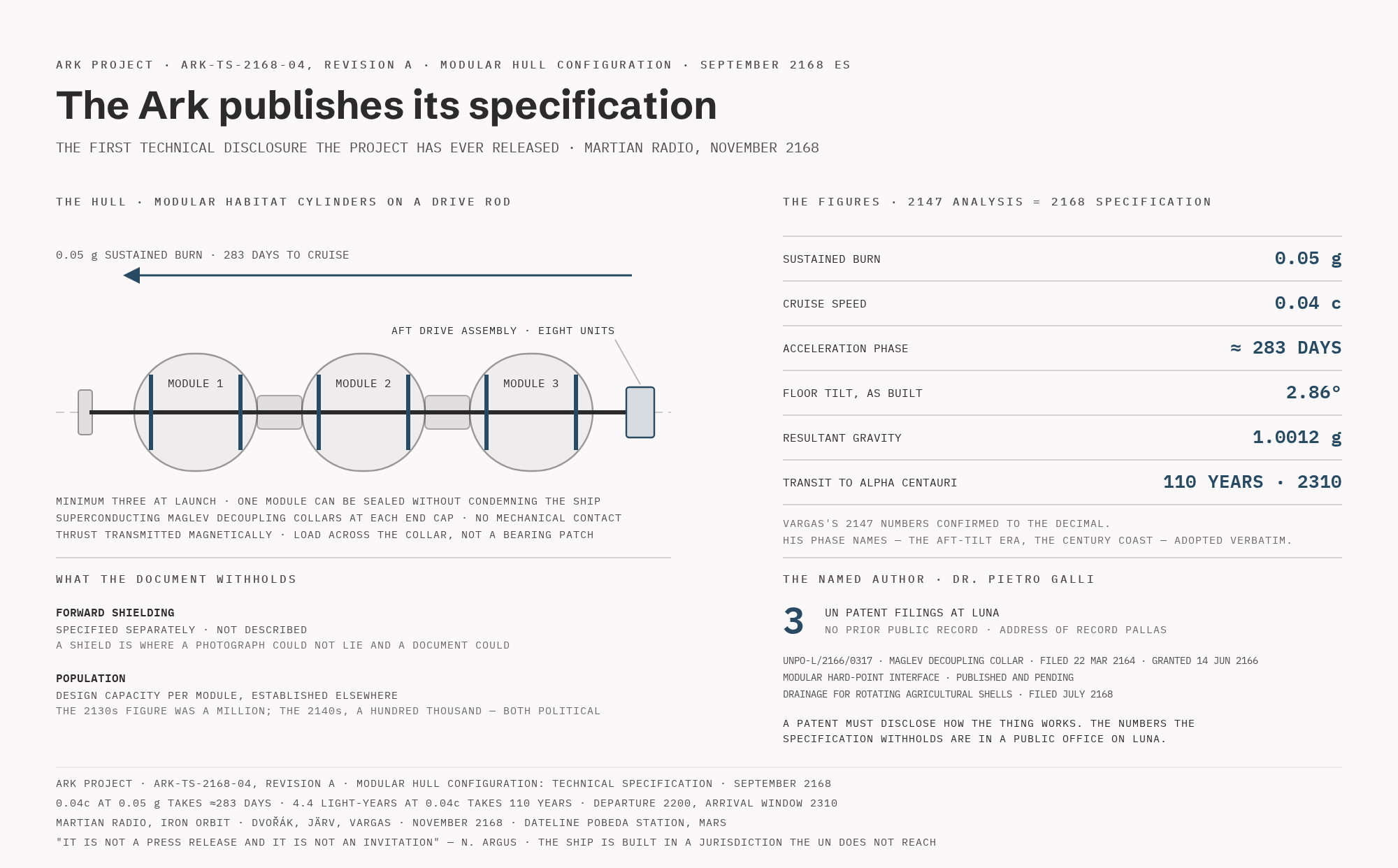
Figure from Martian Radio “Iron Orbit”: The Ark Publishes Its Specification (2168).
Sources
- TWN: James E. Crawford on The Ark (2130)
- TWN: What’s Actually Being Built at Pallas (2147)
- TWN: Dr. Nathaniel Argus Names Himself the Ark’s Funder and Voice (2149)
- Martian Radio “Iron Orbit”: Who Nathaniel Argus Actually Is (2149) — Beaumont theory: Ark’s true purpose may be finishing Gisa Argus’s organic-brain embodiment work outside UN jurisdiction
- Pietro Galli — Superconducting Magnetic Decoupling Collar for Rotating Habitation Modules, Patent UNPO-L/2166/0317 (2166)
- Martian Radio “Iron Orbit”: The Ark Publishes Its Specification (2168)
- The Peer Review — The First Write (2171) — departure window 2200; “the last ship of the slow era”
- The Ark Project — The Cradle at Pallas: Organic Soil, Not from Earth (2175) — agricultural shells stocked with Pallas-made soil; first of the systems-under-construction notices
- The Peer Review — Antimatter at the Reserve: The Efficient Drive, the Ark, and the Bond (2179) — Solano antimatter-nozzle paper, AED patent, Bond register 39% trace; fuel arithmetic rules out an antimatter stage; the off-register propulsion question left open
- UN Office for Colonial Development: Citizen’s Guide to Governance (2195) — private registry; not a UN vessel; first object to test the Charter’s gap for vessels built outside any settlement
- UN Colonial Census Bureau — The Bounds, Revised: The Settled Sphere in 2195 (Nov 2195) — Pallas as construction site; the 2200 compilation is “the first after the Ark’s departure”
- UN Weekly: The Ark Leaves Pallas Early as Argus Denies the Copies (22 Dec 2199) — departure 19 December with 5,400 colonists and 620 crew; OETG Article 4.1 action and unenforceable warrant; GISA; allegations and denials; destination undisclosed