Dr. Hélène Thibault and Dr. Alistair Finch
Luna Research Dome 1, Theoretical Physics & High-Energy Metrology Division
Published: Journal of Exotheoretical Physics & Metrology, Vol. 130, Issue 3, 4 September 2172 ES
Approved for Public Release — UN Science Directorate (Unrestricted Academic Distribution)
Abstract
The 2154 SNOBA paper was careful about the limits of its own instrument. The coverage of it was not. Three claims have attached themselves to the result in the eighteen years since, none of which appears in the paper and two of which the paper preempted in terms: that the array resolved displacements at m, that the correlation with the de Sitter memory term was established to eight decimal places, and that the array’s test masses crossed in absolute acceleration. This review restates what the array measured, sets the figures of record, and separates three questions that the citation record has run together. That the low-acceleration term exists was established in 2154. That a vacuum information sink can be generated under human control was established in 2171, by an experiment the first result made predictable. That a gradient drive is buildable remains a thermodynamic problem for which no threshold has been established in either direction.
1. Why this review exists
The interval between 2154 and 2171 was not a period of dispute. It was a period in which the field had a mechanism and no measurement that could be made with it. The 2171 advance communication (Novikov, Larionova, Liang) closed that interval by generating a vacuum information sink in a laboratory enclosure, which converts a claim about what the universe permits into a claim about what human engineering can reach.
That conversion has consequences for how the 2154 result is read, and the reading has drifted. The framework is now cited in support of positions about propulsion economics, about the standing of machine-originated theory, and about the purposes of the Spacer sites, in each case more strongly than the 2154 measurement supports. The drift began in the coverage of the paper and is not confined to it. Reference works, programme documents, and a substantial fraction of the secondary literature repeat a sensitivity figure that the array never had and that the paper never claimed.
This review is written by two of the four 2154 authors. Our concern is not with the paper. It is with what has been built on top of it, and with three figures that were never in it.
2. The framework, stated
The literature cites the 2154 result under four names: emergent entropic gravity, emergent gravity, entropic gravity, and the Verlinde framework. We use entropic gravity throughout, and Verlinde Noise for the decoherence signature. We use vacuum information sink, the 2154 coinage, in preference to the shortened “information sink” that has appeared since 2171.
The framework reduces to four propositions. Stated in this form it is short, and most of what follows concerns what the four do not settle.
P1. There is no fundamental tensor mediator of gravitation. The observed spectrum contains no tensor-field boson. The 2154 null was an event-count limit, not a displacement limit, and is restated as such in Section 4. General Relativity is retained as the high-acceleration effective description, in the same relation to entropic gravity that fluid dynamics bears to statistical mechanics.
P2. The force on a body is , where is the Unruh temperature associated with the body’s acceleration and is the gradient of entropy density on the local holographic screen. In the high-acceleration limit this expression reproduces the metric description to within the precision of every measurement made before 2151.
P3. Below the entropic term dominates, producing an additional inward acceleration that scales with rather than with enclosed baryonic mass. The 20th- and 21st-century literature absorbed this term into particulate dark matter. The framework does not remove the term. It changes what the term is made of, from unseen mass to the elastic response of the cosmological horizon against displaced vacuum entropy.
P4. A region in which vacuum information density is suppressed relative to its surroundings presents a to any body crossing it, with the force directed along the gradient. The fractured Spacer exomaterial at Styx and Kerberos does this; this is the 2154 reinterpretation of the instrument anomalies recorded there in the 2139 assessment.
The framework’s central incompleteness should be stated as plainly as the four propositions. Entropic gravity does not give as a function of matter distribution. It takes the holographic screen as given, measures the screen’s response, and says nothing about what sets the entropy density of any particular region. Every engineering question in Section 5 is downstream of that gap. It is why the propulsion programme is a materials and stability programme rather than a theory programme.
3. What SNOBA measured
Design logic. Three free-flying platforms in mutual free fall, arranged in an equilateral triangle with a 10,000 km laser-interferometric baseline, carrying magnetically levitated beryllium-9 condensates. The observable is the relative displacement between test masses. The common-mode component of the solar gravitational field cancels in that channel, leaving the residual non-gravitational acceleration of the platforms, held below . The 2154 apparatus table gives this residual figure and the differential figure as separate rows, which is the distinction Section 4 deals with.
Why the array had to be at 30 AU. The relevant quantity for the entropic transition in a differential measurement is the acceleration difference across the baseline, not the absolute heliocentric acceleration. For a baseline at heliocentric distance this is of order . At 30 AU with a 10,000 km baseline the radial component is and the transverse component , both below . The same baseline at 1 AU gives , four orders of magnitude above it.
The design choice is therefore load-bearing rather than incidental. The regime is reachable at Neptune distance with a m baseline and is not reachable inside the belt at any baseline a free-flying array can hold. The 2154 paper set this reasoning out in its Section 1 and again in its apparatus table. It is restated here because it is the load-bearing part of the result and is routinely dropped in citation, with the consequence that the crossing is reported as an absolute acceleration and appears unreachable at 30 AU.
The two signatures. Transverse variance in the relative coordinate, scaling as in the low-acceleration limit, matching the holographic variance expression with a correlation of . Separately, an anomalous inward acceleration appearing once the differential acceleration fell below , in a volume containing no dark-matter mass density. The first is the Verlinde Noise. The second is the term of P3.
Deployment record. Deployed 2150 to 2153. Interferometric lock achieved 2151, followed by 36 months of continuous observation. The array was built to detect a tensor-field signature from Spacer hardware and detected none. It was not built to test entropic gravity, and the fact that it did so is a consequence of the instrument’s noise floor, not of its design intent.
4. Figures of record
None of the claims below appears in the 2154 paper. Each is in circulation in the secondary literature, and the paper preempted two of them in terms. Each is traced here to its point of entry.
| Claim as circulated | Figure of record |
|---|---|
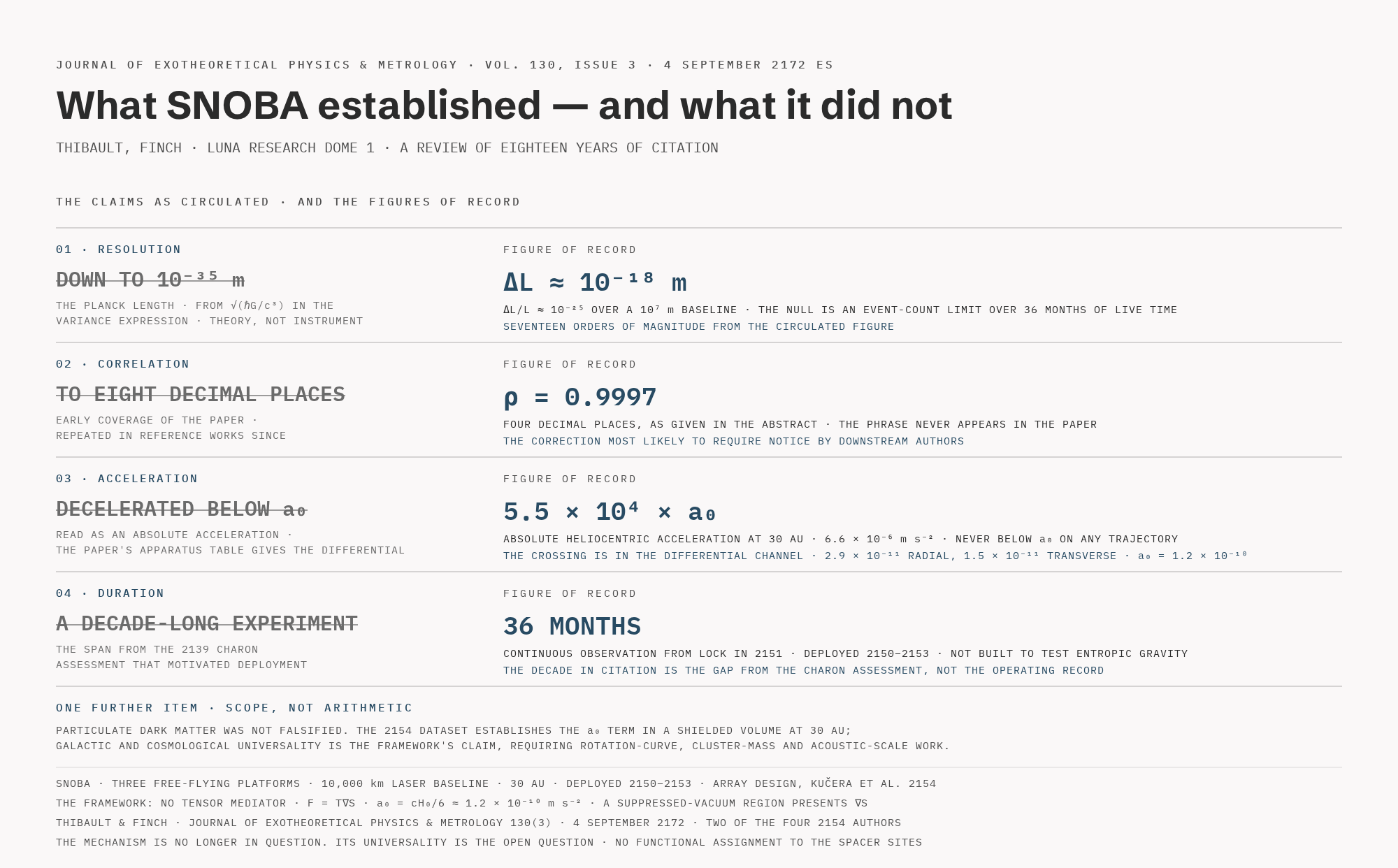
| The graviton null was established “down to m.” | m is the Planck length. It entered the literature from the factor in the variance expression given in Section 3.1 of the paper, where it belongs to the theory and not to the instrument. The array’s specified resolution is over a m baseline, that is m. The null is an event-count limit over 36 months of live time. The paper states both figures and labels them; they differ by seventeen orders of magnitude and describe different quantities. |
| The de Sitter memory term was confirmed “to eight decimal places.” | , quoted to four decimal places. The eight-decimal phrasing appears in early coverage of the paper and has been repeated in reference works since. The paper’s abstract gives and does not use the phrase. This is the correction most likely to require explicit notice by downstream authors. |
| The test masses were decelerated below . | The crossing is in the differential channel, as set out in Section 3. The absolute heliocentric acceleration at 30 AU is , which is times , and it never falls below at any point on the array’s trajectory or at any distance the array could have been deployed to inside the heliopause. Read literally, it describes a measurement the array could not have made; the paper’s own apparatus table gives the correct figure. |
| SNOBA was “a decade-long experiment.” | Deployed 2150 to 2153, with 36 months of continuous observation from lock in 2151. The paper gives the deployment record; the longer interval is the span from the 2139 Charon Anchor assessment that motivated the deployment. The two are commonly conflated in citation. |
One further item is a matter of scope rather than arithmetic. A portion of the subsequent literature reports that particulate dark matter was falsified. The 2154 dataset establishes the term in a shielded volume at 30 AU, and the paper states the limit of that claim explicitly. That the same term accounts at galactic and cosmological scales for the phenomena previously attributed to unseen mass is the framework’s claim, and confirming it requires rotation-curve, cluster-mass, and acoustic-scale work that postdates the array and that no SNOBA dataset bears on. The mechanism is no longer in question. Its universality is the open question, and it is listed as such in Section 6.
5. What changed, 2154 to 2172
The Liang framework changed category. In 2142 it was physically forbidden: under General Relativity a spacetime gradient requires an energy-momentum tensor, and neither Spacer site contains the mass-energy to supply one. After 2154 it was physically permitted and engineering-impossible. After 2171 it is engineering-possible and economically distant. Each step removed an obstacle and left a larger one in its place, which is the ordinary shape of a technology that arrives over decades.
The 2171 experiment. Sixteen coaxially arranged field-coil stacks around a 0.4 m³ enclosure at 4.2 K, driven at 4.7 MW peak from the Dome 1 fusion plant, against a levitated beryllium-9 condensate instrumented with SNOBA-class readout. Transverse variance suppressed by 71% ± 4% within the driven volume against the SNOBA free-space baseline. Anomalous recoil above a drive power density of 2.1 MW m⁻³, consistent with to within a factor of 3.1, with no free parameters fitted. Eleven uncontrolled relaxation events over the operating record, each reproducing the Styx and Kerberos instrument signature: negative-distance rangefinder readouts and gyroscopic ghost drift in adjacent equipment. No recurrence pattern has been identified.
The relaxation events are the most consequential entry in that list and the least discussed. A drive requires a controlled sink. Eleven uncontrolled relaxations in a 214-hour operating record is a stability problem, not a nuisance, and the 2171 paper brackets the events without explaining them.
The thermodynamic constraint. Mechanical-equivalent efficiency was on the worst run and on the best. We caution against reading this figure next to a fusion torch’s performance: it is a mechanical-equivalent efficiency, not a jet efficiency, and the two are not interchangeable without a stated conversion. What can be said without that conversion is that the sink’s energy conversion sits six or more orders below the class in which a Kuzmin torch operates, and that a useful gradient drive must close most of that interval. No threshold has been established in either direction. The 2171 paper’s closing formulation, that the binding constraint is thermodynamic rather than physical, is the correct summary of the position and has not been improved upon.
The prediction record. Two predictions were placed on the public record in 2171: field equations for a sustained efficient gradient by the early 2180s, and an engine by 2201. Neither has been met. Neither has been falsified. The first remains open, and no candidate formulation has appeared in the open literature.
Machine-originated theory. The 2142 CAI null result, in which the instance was tasked with deriving the field equations and returned no candidate solution, is now read in the machine-cognition literature as a question error rather than a capability bound: the instance was asked to solve for in a regime where the mass-energy term is absent, and the correct question was always the gradient term. The reading is plausible and we hold no view on it. We record only that the field’s foundational result came from an instrument built to look for something else, by a division that had settled the instrument’s design logic for unrelated reasons, which is an observation about metrology rather than about cognition.
The Spacer question. The framework predicts what a structured entropy gradient does to a body crossing it. It does not say that the Charon Anchor complex is such a structure, that the recovered Kuiper Belt hardware is such a device, or what either was built for. The recovered drive’s operating principle and control architecture remain uncharacterized after forty years of study, and the 2171 paper explicitly makes no claim about it. No functional assignment to either site is made in this review, and the inference that the Spacers engineered entropic gravity is an inference from capability, not a measurement.
6. Open problems
- What sets entropy density. The framework measures the response of the holographic screen and does not predict from a matter distribution. No experimental programme addresses this. It is the framework’s central incompleteness and it gates every item below.
- Galactic and cosmological universality. Whether the term measured at 30 AU reproduces rotation curves, cluster mass estimates, and the acoustic scale. See Section 4.
- Sink stability. Eleven relaxation events in 214 hours, no identified recurrence pattern, no proposed mechanism. Unstable sinks are not drives.
- Efficiency. No threshold for a useful gradient drive has been established. The interval between and a useful figure is unmeasured at both ends.
- The Spacer sites. The operating principle of the recovered hardware, the function of the Charon Anchor complex, and the relation between either and the entropic framework. Not a physics problem, and not one this review can progress.
References
- Kučera, M., Finch, A., Thibault, H., Sakamoto, H. (2154). Direct Observation of Holographic Vacuum Decoherence and the Verification of Emergent Entropic Gravity at the Sun-Neptune L4 Lagrange Point. Journal of Exotheoretical Physics & Metrology, 112(4). — wiki page
- Liang, Q. (2142). A Common Origin: Comparative Structural Analysis of the Charon Anchor Complex and the Kuiper Belt Vessel, and a Candidate Framework for Gravitic Propulsion. UN Journal of Applied Physics. — wiki page
- Dome 1 Xenomaterials Division (2139). Technical Report: The Charon Anchor and the Styx/Kerberos Debris Field (restricted; cited portions authorized for release). — wiki page
- Novikov, A., Larionova, Y., Liang, Q. (2171). First Controlled Generation of a Vacuum Information Sink: An Induced Entropic Gradient in a Laboratory Enclosure. Journal of Exotheoretical Physics & Metrology, 129(1). — wiki page
- The Peer Review (2171). Segment: The First Write. Luna University campus broadcast, 18 February 2171. Transcript. — wiki page