N. Haddad, E. Sandvik (Boreas Station Medical Service, Titan orbit) A. Vos, E. Kowalczyk (Luna Research Dome 4, Biomedical Research Division) Submitted 4 December 2179 ES. Clinical follow-up and archive reanalysis conducted under the standing Saturnian containment protocol.
Abstract
Mirror-fold encephalopathy (MFE), the first identified human disease caused by templating across the L/D-chirality barrier, is reported. The index case presented to the Boreas Station Medical Service on 4 March 2176 with a fourteen-week history of progressive headache and word-finding difficulty. Beta-sheet-binding imaging was positive in frontal and temporal cortex. Every chirality-specific reagent in the station’s standard panel was negative, including the confirmatory immunoassay used to establish a proteinopathy diagnosis. A TIGR-Tas-lineage clearance regimen produced a partial clinical response at six weeks and relapse at eleven weeks. Tissue analysis identified a beta-sheet aggregate built from an endogenous L-chiral protein but stacked with the mirror image of the canonical sheet registry, a fibril of opposite twist to which L-chiral antibodies, L-chiral proteases, and the molecularly imprinted receptors of the standard panel are blind by construction. Retrospective review across the Saturnian system identified 17 confirmed and 41 suspected cases with the same discordant pattern. Reanalysis of 214 archived cases of undetermined proteinopathy across the settled sphere returned 19 positive, the earliest from 2151. Reconstruction of exposure from manufacturing and dispensary records for the free-licensed D-chiral peptide therapeutics introduced in 2130 gives a documented recipient floor of approximately 310,000 system-wide. Screening of 1,240 living recipients returned 14 positives (1.13 percent). Under permissive assumptions about undetected cases the rate is 3.6 percent. The corresponding prevalence is between 3,400 and 11,200 infections, of which the large majority are presymptomatic. Nineteen cases in the series had no record of therapeutic exposure; a second route through the mirror biocatalysis enzymes released under the same 2130 licence is considered and not excluded. No treatment exists. A candidate clearance agent, MFB-1, was selected against mirror-fold fibrils seeded in vitro from the synthetic template and produced as an ordinary L-chiral binding protein; it disaggregates and clears patient-derived aggregate in cortical culture. No in vivo efficacy data are reported.
1. Introduction
Prion-style templating across the chirality barrier was identified aboard Korolev at Boreas Station in 2109, in an Earth-origin L-chiral control culture that should have been biochemically inert to the D-chiral material under study (UN Weekly, 2109). The mechanism requires no enzymatic grip on a whole molecule. A structural motif with no handedness to break is sufficient to template. Every confirmed-D-chirality moon had been placed under Callisto-level containment during the 2108 Saturnian survey, and the containment programme at Boreas has operated continuously since the 2109 finding.
The programme was built on one assumption: that the barrier is crossed by contact with the D-chiral biosphere. It was not.
Dome 4’s single-protein mirror-synthesis protocol, standardized after the 2118 shared-ancestry finding, made D-chiral chemistry an industrial input. In 2130 the division released a class of protease-resistant D-chiral peptide and protein therapeutics under free license, together with mirror enzymes for biocatalysis (UN Weekly, 2130). The patent was released rather than held, following the open-license precedent of Neuromorphic Foundries’ 2062 release. No central recipient registry was established, because there was no licensor to keep one.
In 2141 the same toolkit was inverted: a D-chiral enzyme was used purely as a structural template for an L-chiral protein built to act on human substrate (Kowalczyk et al., 2141). The paper that reported it treated the inversion as an application rather than a discovery. This paper reports what the same inversion does when the target is a disease.
2. Index Case
Patient A, a 63-year-old female hydroponics systems technician on the Titan surface, registered at Boreas Station. Presented 4 March 2176 with a fourteen-week history of progressive headache and intermittent word-finding difficulty. No focal deficit on examination. Executive slowing was present on formal testing and had not been documented at her last occupational assessment four years earlier.
History of a chronic inflammatory condition, treated continuously between 2144 and 2151 with a D-chiral peptide immunomodulator of the 2130 class. No family history of neurodegenerative disease. No occupational assignment inside a containment zone at any point.
Beta-sheet-binding imaging was positive in frontal and temporal cortex. Cerebrospinal fluid was negative on the station’s confirmatory immunoassay, negative on the seeding assay, and negative on the genetic panel. On the imaging result a TIGR-Tas-lineage clearance regimen was administered under licence. Partial clinical response was recorded at six weeks and relapse at eleven weeks, with extension of the deficit. Repeat imaging showed progression. Repeat immunoassay remained negative.
The discordance was recorded as probable assay failure. It was referred for tissue study on that basis.
3. Diagnostic Discordance
The station panel uses two chemically distinct classes of reagent, and the distinction is the reason the case was missed.
Small-molecule beta-sheet tracers bind by groove insertion and aromatic stacking and are, to first approximation, chirality-agnostic. They report the presence of a beta-sheet aggregate whatever its handedness. Antibodies, molecularly imprinted polymer receptors, and protease-based clearance payloads are chirality-specific by construction. The Project Prometheus sensor suite (2122) is tuned to exposed beta-sheet conformations, which is to say to the canonical face. Seeding assays fail for the same reason: a mirror template does not recruit normal-fold substrate into the reaction.
In Patient A, every chirality-agnostic reagent was strongly positive and every chirality-specific reagent was negative. That pattern does not exist in the differential, and it was read as two separate faults rather than one finding.
4. Structural Characterization
Frontal cortical tissue was obtained by biopsy and, in the deceased cases described in Section 5, at autopsy. Solid-state nuclear magnetic resonance and electron microscopy identified a beta-sheet-rich fibrillar aggregate with a sheet registry that is the mirror image of the canonical conformation. The monomer is an endogenous L-chiral protein; what is inverted is not its chemistry but its packing. The patient’s own protein is stacked into a fibril that twists in the opposite sense to the canonical aggregate, and every chirality-specific reagent in the panel recognizes the twist, not the residues. The template is not endogenous. A short peptide fragment, consistent with a metabolite of the 2130 therapeutic class, was recovered in association with the fibril edge in all six specimens examined.
The fragment has two parts, and each explains one property of the disease. Its templating face is a glycine-rich segment. Glycine is the only proteinogenic amino acid without a chiral centre, and a run of glycine presents a backbone motif with no handedness to break; it can seed an L-chiral host protein because there is nothing in it for the host to reject. Its flanking residues are D-chiral, and these are why it persists: no human protease can cut them. The template is protected by the chirality it carries and effective through the chirality it lacks. Which way the seeded fibril twists is set by the D-chiral flanks, which is why the result is the mirror registry rather than the canonical one. This is the mechanism Ibn-Rushd described in 2109 (UN Weekly, 2109). What is new is the route: the template was administered rather than encountered, which is why the disease is not confined to the six Saturnian D-chiral moons or to any containment zone.
We propose the designation mirror-fold encephalopathy (MFE) for the clinical entity. The colloquial form in use at the station, and in the Saturnian press since the first suspected cluster was reported, is mirror prion.
5. Retrospective Case Series
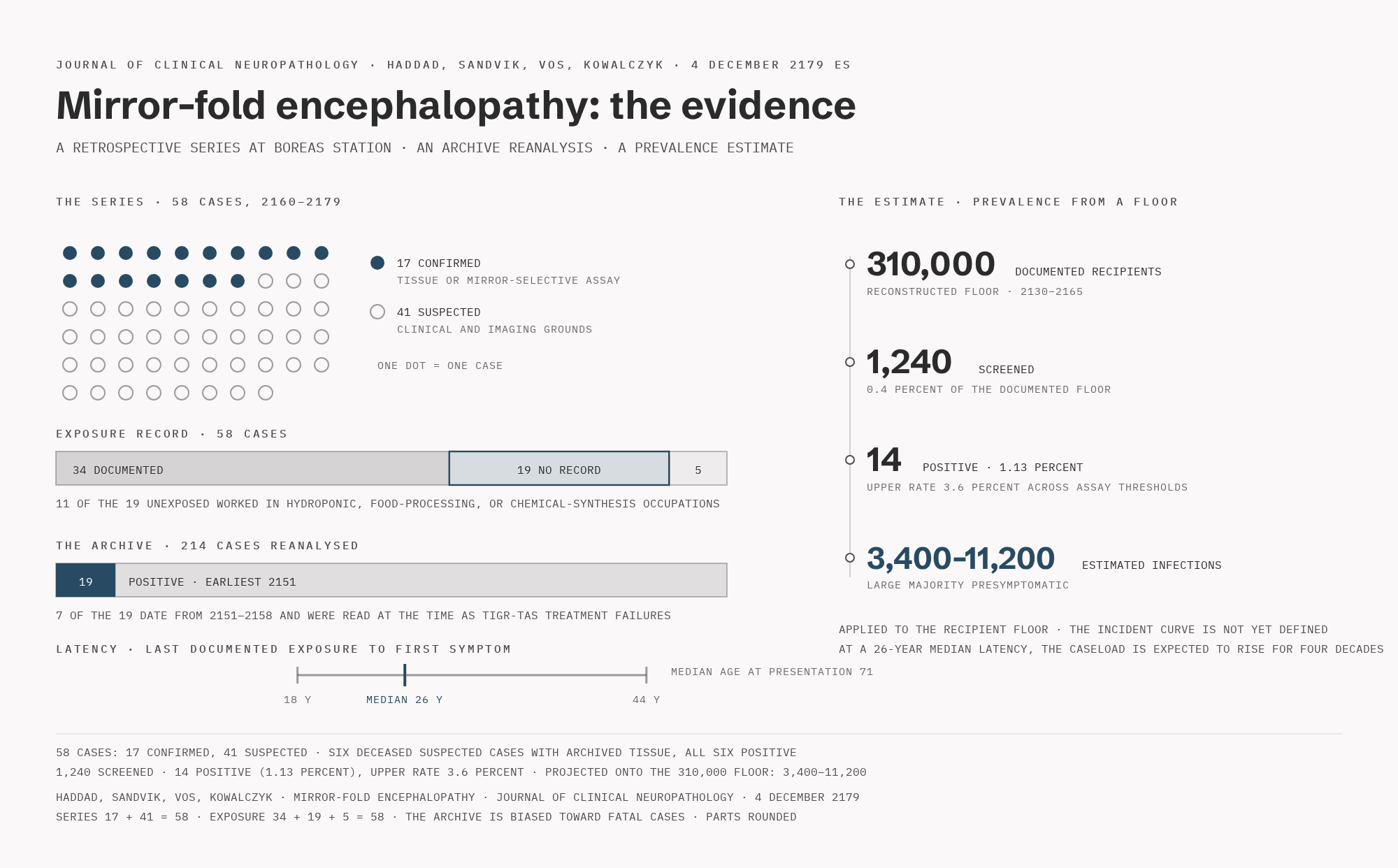
Station and Titan surface records from 2160 to 2179 were reviewed for the discordant pattern: positive chirality-agnostic imaging, negative chirality-specific confirmation, progressive course, no pathogenic variant. Seventeen cases were confirmed by tissue analysis or by the mirror-selective binding assay derived from the work reported in Section 8, and 41 were classified suspected on clinical and imaging grounds. Six deceased suspected cases had archived tissue, and all six were positive.
Median age at presentation was 71. Median interval from last documented exposure to first symptom was 26 years, with a range of 18 to 44. Thirty-four of the 58 confirmed and suspected cases had a documented course of the 2130 class, 19 had no record of exposure, and records were incomplete in the remaining five.
Archived tissue from 214 cases of undetermined proteinopathy held across the settled sphere was reanalysed by the same method. Nineteen were positive. The earliest positive specimen dates from 2151. Seven of the nineteen date from 2151 to 2158 and were recorded at the time as treatment failures of TIGR-Tas-lineage clearance, the same reading given to Patient A twenty years later.
6. Exposure Reconstruction
The 2130 patent was free-licensed. Nothing was registered to a licensor, and no system-wide recipient record exists.
The exposed population was reconstructed from four partial sources: manufacturing lot records held by eleven producers; dispensary logs at fourteen facilities; two settlement health authorities that maintained their own registries; and the licensed formularies. The reconstruction yields approximately 310,000 documented recipients of the 2130 class between 2130 and 2165. The class remained in use after 2165 and the figure is a floor, not a total.
The leading hypothesis, consistent with the structural finding, is that the finished product carried trace D-chiral template fragments, that these persisted in a minority of recipients because the body has no L-chiral protease capable of degrading them, and that in a further minority they templated an endogenous protein. Causation is not established by the data in this paper. Association is temporal, structural, and consistent across every case in which exposure could be documented.
The nineteen cases with no record of exposure are not explained by this hypothesis and are not dismissed. The 2130 release included mirror enzymes for biocatalysis alongside the therapeutics. These entered industrial synthesis under the same free licence, including nutrient-medium and feedstock processing for hydroponic agriculture in the Saturnian system, and were never tracked as medicines. They appear in no formulary and no dispensary log. Eleven of the nineteen unexposed cases worked in hydroponic, food-processing, or chemical-synthesis occupations. A second route, by ingestion or occupational contact with trace template carried through a biocatalytic process, is considered and not excluded. If it exists, the recipient floor in this paper understates the exposed population by an amount that cannot be estimated from the records available.
7. Prevalence Estimate
Screening of 1,240 living recipients in the Saturnian system with beta-sheet imaging and the standard panel returned 14 positives, or 1.13 percent. The sample over-represents recipients who remain reachable and alive, and the tracer is insensitive to early disease, so the point estimate is treated as a floor. Sensitivity analysis across assay thresholds gives an upper rate of 3.6 percent.
Applied to a recipient floor of 310,000, the range corresponds to between 3,400 and 11,200 prevalent infections, of which the large majority are presymptomatic at the time of writing. The incident curve is not yet defined. With a median latency of 26 years and an exposure window that opened in 2130 and has not closed, the clinical caseload is expected to rise for a further four decades on the observed latency alone.
Three limitations are material. The recipient figure excludes all producers and facilities that kept no logs. The attack rate is derived from a screened sample of 1,240 people and a series of 58. The tissue archive is biased toward fatal cases.
8. A Mirror-Selective Clearance Agent
Every therapeutic in the existing antiprion lineage recognizes the canonical fold and cannot be expected to recognize its mirror.
The method reported here reverses the 2141 logic. In 2141 a D-chiral molecule was used as the template for a drug. Here a D-chiral molecule is used to manufacture the target. The template fragment recovered in Section 4 was synthesized with the Dome 4 single-protein protocol and used to seed recombinant human monomer in vitro. The resulting fibrils were indistinguishable from patient-derived aggregate by solid-state NMR and electron microscopy, which for the first time gave the team a supply of the disease’s structure that did not depend on biopsy. A naive L-chiral phage-display library was panned against these fibrils, with counter-selection against canonical-fold fibrils of the same protein, so that only binders to the mirror twist survived. The selected binder was produced as an ordinary L-chiral protein.
The resulting agent, designated MFB-1 (mirror-fold binder 1), is a bivalent binding protein. It bound patient-derived aggregate at sub-nanomolar affinity, disaggregated fibrils in human induced pluripotent stem cell-derived cortical culture, and showed no binding above background across a panel of forty normal-fold human proteins. Because the agent is L-chiral, it can be produced in standard bioreactors and delivered on the TIGR-Tas chassis, whose blood-brain barrier delivery chemistry has been solved since 2164.
The mirror toolkit’s contribution was the target, not the drug. Station clinical staff have taken to calling MFB-1 “the killer.” The authors do not endorse the usage.
No in vivo data are reported. No safety data exist. No process exists at manufacturing scale.
9. Discussion
The containment programme has watched the Saturnian D-chiral moons since 2109 and did not fail. The breach came through a free-licensed medicine synthesized from the same archived library, administered systemically, and distributed without a recipient register for forty-nine years. A containment regime that covers moons and not manufacturing chains is a regime that covers the wrong thing.
The 2118 paper’s open question, whether the conserved chemistry of the D-chiral biosphere bears on the Mirror Fold mechanism, has not been addressed in sixty-one years (Ibn-Rushd et al., 2118). It is addressed here by circumstance rather than by study.
On liability the position is simple and unwelcome. The patent was released. There is no owner. The producers number at least eleven and the recipients at least 310,000. The reliability question for chiral delivery architectures has been before the Luna Interplanetary Court since Nova Biosciences filed against Dome 4 in 2155 over the cryosleep clearance architecture, a proceeding that per The Peer Review has kept the question in litigation and out of engineering review for the whole of the incubation period (The Peer Review, 2167). The reliability record in that proceeding includes chiral clearance failures from the same years as the seven earliest archived positives in Section 5. Whether any failure entered in that record was a case of MFE has not been examined. The authors had no access to the case file.
Four measures follow from the findings and none is in place. A system-wide exposure register for licensed D-chiral therapeutics, retrospective to 2130. Reanalysis of every tissue archive held under an undetermined proteinopathy classification. Screening of living recipients. And extension of the containment protocol to synthesis and manufacturing chains rather than to sites alone, including the biocatalytic processes in which the 2130 mirror enzymes are used.
When MFB-1 or an equivalent reaches licensure, it will be a product with a price, distributed from a licensed station, to a population of at least 3,400 people who are presently unaware they are in it.
Acknowledgments
The authors thank the Boreas containment programme for archive access and containment-zone exposure records, the Dome 4 Xenobiochemistry group for mirror-synthesis support, and the Titan surface health authority for dispensary reconstruction. Tissue reanalysis was conducted under Xenobiology Archive permit. The families of the six deceased patients consented to publication of the structural findings.
References
- Ibn-Rushd et al., “Enantio-Biochemistry of the Callisto Ecosystem” (2104)
- UN Weekly, “Mirror Fold: Fleet Split” (2109)
- Ibn-Rushd et al., “One Root, Seven Worlds: Comparative Genomic Evidence for Shared Ancestry Among the Sol System’s Chirally-Inverted Ecosystems” (JACS, 2118)
- Nova Biosciences, “Project Prometheus Dossier” (2122)
- UN Weekly, “Dome 4 and Pathfinder Korolev Announce Free-Licensed Mirror-Chirality Therapeutics” (2130)
- Kowalczyk et al., “Breaking the Two-Year Revival Ceiling: A Mirror-Synthesized Enzyme for Rapid Cryoprotectant Clearance” (Journal of Applied Cryobiology, 2141)
- Murphy & Spencer, “TIGR-Tas: Targeted Nanoscale Gene-Editing Complex for Prion, Huntington’s, and Amyloid-Associated Neurodegeneration” (2110)
- The Peer Review, “The Cells: Biomedicine Overview” (2155)
- The Peer Review, “The Cells: Science Roundup” (2167)