Mirela Constantin spent nineteen years as a relay engineer on the cislunar network of the UN Office for Lunar Affairs (UNOLA) before its dissolution under Article IV of the Charter of 2101 moved her section, and the network, to the new UN Relay Directorate. How the UN Relay Works Across the Solar System was published the following year by Luna University Press, which issues only electronic editions. Constantin’s preface explains why: a printed book would take months to reach Ceres by freighter, and an electronic one arrives about half an hour after it leaves Luna. “This book will reach you the way it describes. If you are reading it at Tianshui, it has already made the trip in Chapter Four.”
The book is written for residents rather than engineers. It has no equations and assumes only that the reader owns a terminal. It became, within a year of publication, the standard explanation of the network that every off-world settlement depends on and almost nobody had described in one place.
The Problem: Light Is Slow
The first chapter is a single fact and its consequences. Radio and laser signals travel at the speed of light, and at solar system distances the speed of light is slow. Constantin’s table gives one-way signal times between the inhabited points of 2102:
| Between | One-way delay |
|---|---|
| Earth and Luna | about 1.3 seconds |
| Luna and Mars | about 3 to 22 minutes |
| Luna and Ceres | about 13 to 33 minutes |
| Mars and Ceres | about 8 to 38 minutes |
| Luna and Jupiter | about 33 to 54 minutes |
The ranges are the planets moving. On a good month, Mars is three minutes from Luna. On a bad one, twenty-two. For about two weeks every twenty-six months the Sun sits between them and blocks the direct line entirely.
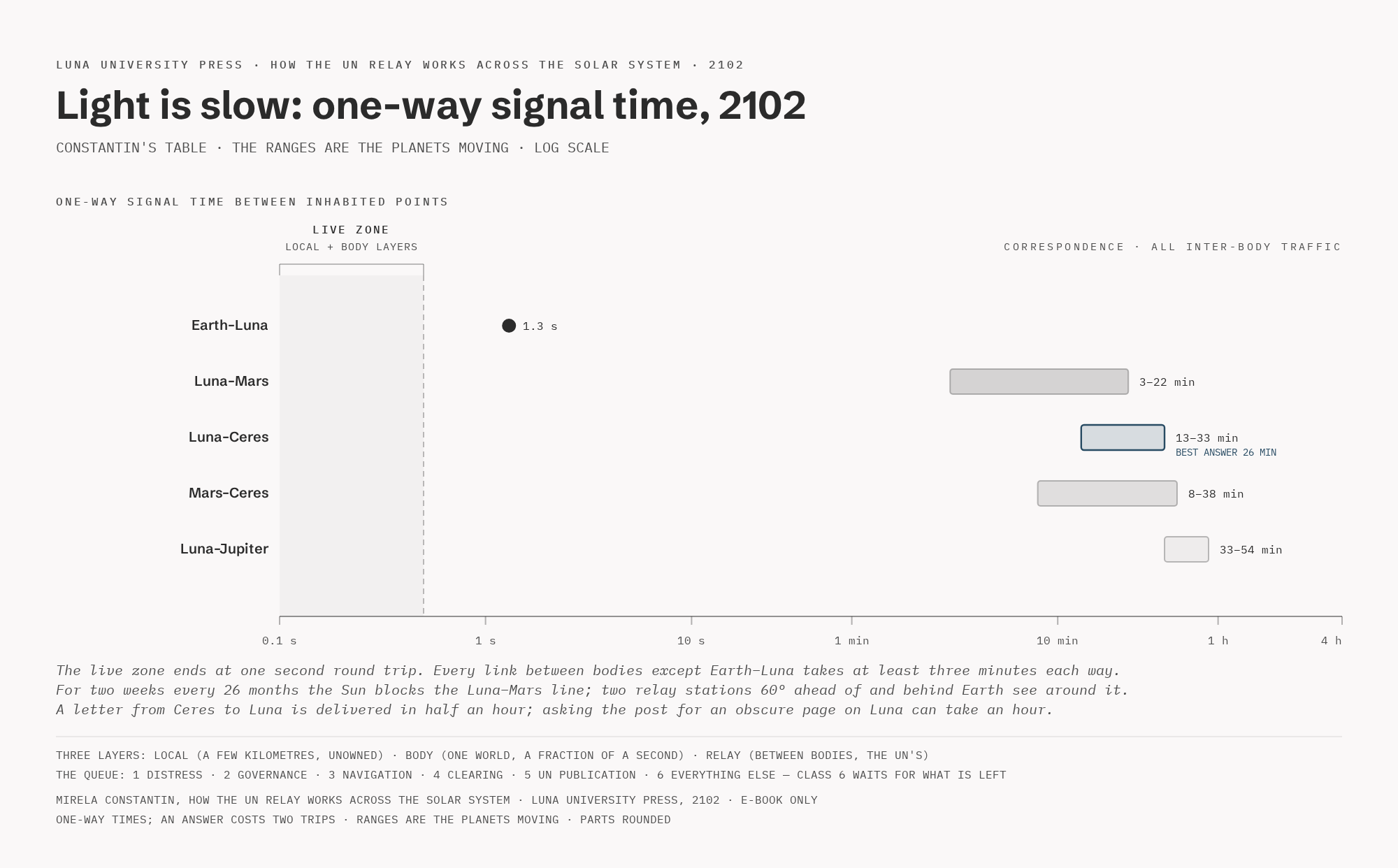
Everything else in the book follows from the table. A conversation needs answers in under a second. Between Luna and Ceres an answer takes, at best, twenty-six minutes. “Nobody on Ceres has ever had a conversation with anyone on Luna,” Constantin writes. “They have had correspondence. The network is built for correspondence. Once you understand that, nothing about it is strange.”
Three Layers
The network is three networks stacked on each other, and the book’s second chapter separates them.
The local layer is everything within a few kilometres: a habitat, a station, a ship, a crater floor. It runs on the habitats’ own wiring and, mostly, on terminals talking directly to each other by radio. Constantin gives the KT, the pocket terminal its due here. Because Yuri Kuznetsov’s 2032 operating system was open, every terminal built on it can pass messages for its neighbours, and a crowd of terminals becomes a network without any operator at all. This is the only layer where things happen live: calls, chat, shared work, games. It belongs to nobody. The UN does not run it, does not log it, and could not switch it off without collecting every terminal in the settlement.
The body layer covers one world. Luna has the Directorate’s surface relays and orbiting satellites inherited from UNOLA. Mars has the Soviet-built surface network and the satellites in Mars orbit, operated from Pobeda and preserved, with the rest of the Soviet Union’s Martian arrangements, by Article IV. Ceres has the Tianshui network, Chinese-built, on which the Ceres News Network and the Tianshui Wire are carried. Within a body the delays are a fraction of a second, so a body network feels like the local layer, only bigger.
The relay connects the bodies. It is a chain of laser trunk stations: ground and orbital terminals at each settled body, and two relay stations far out on Earth’s orbit, sixty degrees ahead of and behind the Earth, whose job is to see around the Sun when the direct line is blocked. This layer is the UN’s. It is the only one with a single owner, and it is the one the book is named after.
The Mailbox
Chapter Four is the one most often quoted, because it explains what residents actually experience.
The relay does not carry conversations. It carries mail. Every message, page, payment, and file is packaged as a sealed bundle, addressed, and handed to the nearest relay node. The node keeps it until the next transmission window toward its destination, sends it, and the receiving node keeps it until the addressee collects it. If a link is down, because of a fault, a conjunction, or a queue, the bundle waits in storage at the last node that had it. Nothing is lost by waiting. It is only late.
Constantin calls this the mailbox principle and gives it three rules. A message is never dropped because the far end is unreachable. Every bundle carries two time stamps, sent and arrived, and both are shown to the reader. And no node depends on any other node to keep working.
What this means in practice:
- News arrives as editions. UN Weekly does not serve its pages from Luna to every reader. It publishes an edition, and the relay pushes a copy to every node. A reader at Tianshui opening UN Weekly is reading the Ceres copy, stamped with the minute it arrived. It is never live. It does not need to be.
- Popular pages live everywhere. UN offices and services keep copies at every node. Anything else that enough people at a node ask for gets copied there automatically, so the second reader does not wait.
- Rare pages must be sent for. A page that exists only on Luna has to be requested. The request goes out as a bundle and the page comes back as one, and the reader waits the round trip plus the queue. Residents call this “asking the post.” At Ceres, asking the post for an obscure page on Luna can take an hour.
- Letters are letters. A message to Luna from Ceres is delivered in half an hour and answered whenever the addressee reads it. People in the outer settlements, Constantin observes, have relearned how to write: complete thoughts, every question asked at once, because a follow-up costs an hour.
The book’s account of the social consequence is brief and has been widely repeated. Off-world residents keep two kinds of friends: local friends, whom they can talk to, and post friends, whom they write to. Most have more of the second.
The Queue
The relay’s trunks are fast, but they are not infinite, and they are shared by everything that has to leave a body. Chapter Five describes how the Directorate decides what goes first. Bundles carry a priority class, and in a congested window higher classes are sent before lower ones:
- Distress and safety. A ship in trouble outranks everything.
- Governance. Council business, governors’ offices, and CAI/Oracle queries and recommendations.
- Navigation and fleet traffic.
- Clearing and administration. Payments, registries, permit filings.
- UN publication. UN Weekly, Directorate notices, the UN’s own services.
- Everything else. Private letters, private sites, personal files.
Class 6 travels on whatever capacity is left. Most days that is plenty. In a heavy window, during a Council session or a conjunction backlog, private traffic waits, sometimes for days. Residents call it “the slow post.”
Constantin is careful to separate this from censorship. The queue delays; it does not refuse. A private letter in class 6 will arrive. She is equally careful to say that whoever writes the classes decides what the outer settlements hear first, and that the Directorate writes them.
Why It Is Not Centralised
Chapter Six answers the question residents ask most: why can’t you simply connect to Luna, the way people on Earth connect to a server?
Her answer is that a central network fails the moment the centre is far away. If Ceres depended on Luna to run its services, every page at Tianshui would take an hour to load and every outage at Luna would switch Ceres off. So the network is built the other way round. Every node keeps what its settlement needs to work alone: its own copies of the UN’s services, its own hosting, its own local news, its own payments that do not leave the body. The relay connects self-sufficient places; it does not hold them up.
Constantin draws the line to Ceres’s own decision. The SP water credit of 2100 is usually told as a monetary story. She tells it as a network story. National currencies at Ceres cleared through Earth, which meant waiting a season for the post, and a currency that settles locally does not wait. “Ceres did not invent a money. It invented a way of not needing the relay to buy a transport.”
Who Can Publish
The relay was built for the UN’s own traffic. Chapter Seven describes what happened to it anyway.
Because any terminal can host pages, and because any page asked for often enough gets copied to other nodes, residents began publishing their own sites on the relay well before the Charter. A miners’ bulletin at Ceres, a Pobeda radio archive, a Luna engineering forum: none were UN services, and all now travel the same way UN Weekly does, at class 6, copied wherever people read them. Constantin estimates that private sites already outnumber UN services on the relay by more than a hundred to one, and that most of them are read by fewer than fifty people. She treats this as the network working rather than failing. “It was built to carry the UN’s voice. It turned out to carry everyone’s, more slowly.”
Martian Radio gets a paragraph to itself. A broadcast is the one kind of traffic that light delay cannot hurt, because nobody expects to answer it. A programme recorded at Pobeda and carried to the belt is exactly as good twenty minutes late. Constantin suggests this is why the most listened-to voices in the outer settlements are radio voices.
What the Relay Sees
Chapter Eight is about privacy, and it is short.
Bundle contents are sealed by default by the terminal that sends them, using the encryption built into Kuznetsov’s stack. The relay cannot read them. It does read their addresses, because it has to know where to send them, and the Directorate keeps routing records. “The relay does not read your letters,” she writes. “It knows who you write to, and when.” Traffic on the local layer leaves no such record, which Constantin offers as a fact rather than advice.
Earth
The final chapter is about the one place the relay does not reach directly.
Off Earth, the relay is a public utility, funded by the UN under the Charter and free to every resident at the point of use. On Earth, the network people use every day is not the relay at all. It is the older terrestrial internet, carried by commercial providers that have charged for access since long before anyone lived on Luna. The relay’s ground stations connect to it through gateways, and Earth’s providers pay for that connection and pass the cost on.
The result is the book’s closing irony, and Constantin lets it stand without comment. A miner on Ceres reads UN Weekly for nothing, half an hour late. A clerk in Geneva reads it a second after it is published, and pays a monthly bill. “On Earth the network is a product. Everywhere else it is part of the air supply.”
Reception
The Directorate made the book available free at every relay node within a month of publication, which it noted was the fastest the relay had ever carried a single file to every settlement. Within the year it had been adopted as the training text for UN relay technicians, and had become the usual thing to hand a newcomer who asked why the post was slow.